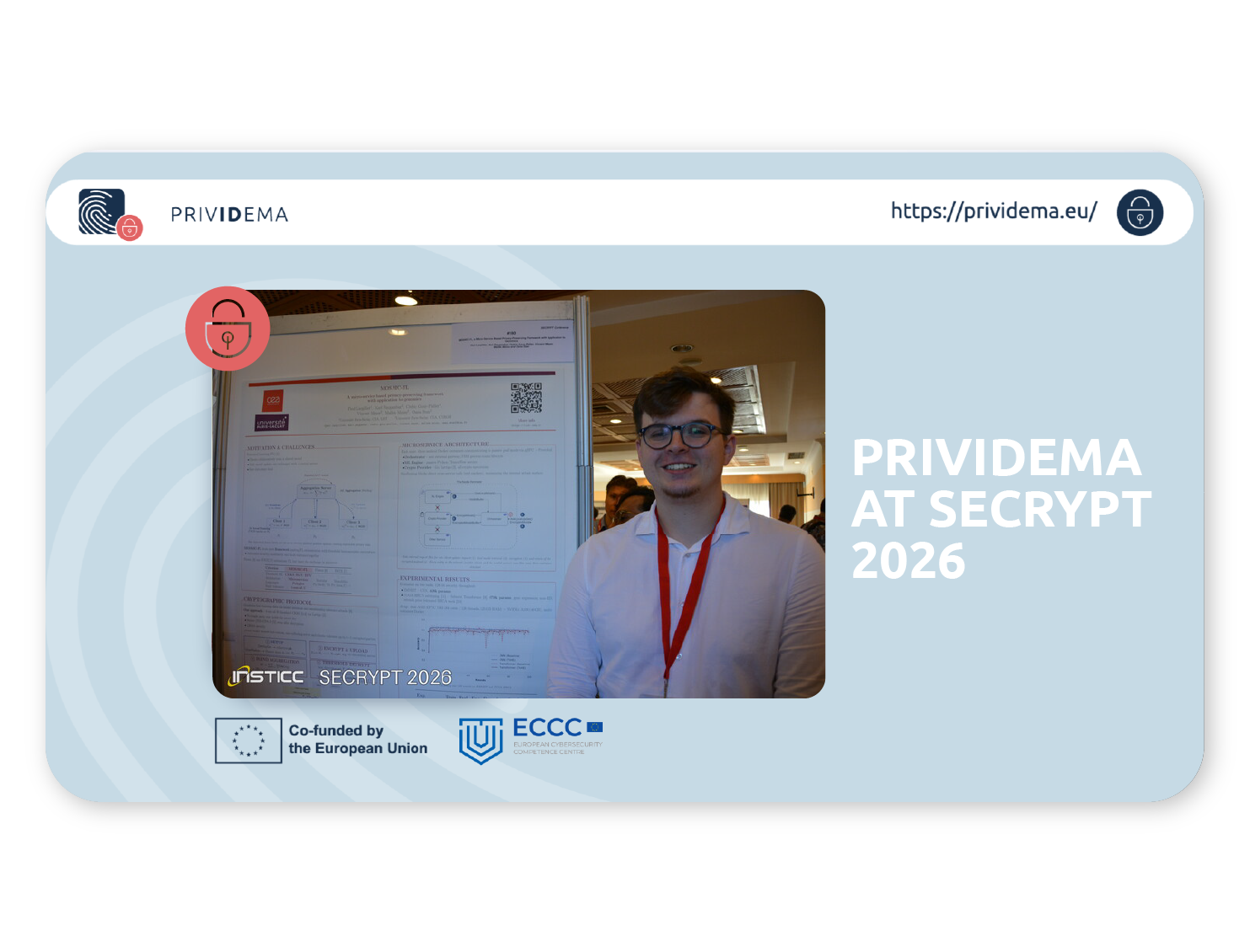
The PRIVIDEMA consortium is pleased to highlight the participation of partner CEA at the 23rd International Conference on Security and Cryptography (SECRYPT 2026), a leading international forum bringing together researchers and practitioners from academia, industry, and government to advance the state of the art in cybersecurity, privacy, and applied cryptography. SECRYPT 2026 focused on topics including data security and privacy, applied cryptography, distributed systems, and security in AI and machine learning.
CEA submitted the paper “MOSAIC-FL: A Micro-Service Based Privacy-Preserving Framework with Application to Genomics”, presenting innovative research on secure and privacy-preserving Federated Learning (FL) for sensitive domains such as healthcare and genomics.
Advancing Privacy-Preserving Federated Learning
Federated Learning is increasingly recognised as a key technology for enabling collaborative AI development without requiring participants to share raw data. However, ensuring strong privacy guarantees and robust security remains a major challenge, particularly when working with sensitive medical and genomic information.
The proposed MOSAIC-FL framework addresses these challenges through a modular micro-service architecture that combines:
- A high-performance gRPC communication layer for efficient distributed training;
- A Finite State Machine mechanism for robust synchronization and threat detection;
- A fault-tolerant secure aggregation protocol based on a threshold variant of the CKKS homomorphic encryption scheme;
- Blind model aggregation capabilities, allowing an orchestration server to aggregate encrypted model updates without accessing their content.
The framework enables secure collaborative learning while reducing communication overhead and maintaining resilience against client failures.
From Research to Real-World Applications
To demonstrate its effectiveness, the framework was evaluated across a range of use cases, from image recognition tasks using the EMNIST dataset to advanced genomic classification scenarios, including breast cancer subtyping on TCGA datasets. The results highlight the feasibility of combining strong privacy guarantees with practical performance requirements in distributed learning environments.
Contribution to PRIVIDEMA
CEA’s participation in SECRYPT 2026 strengthens the consortium’s engagement with the cybersecurity and privacy research community and provides valuable insights for PRIVIDEMA Use Case 2, Scenario 4, where a Federated Learning solution is being developed. The presented work contributes directly to the project’s objective of enabling privacy-preserving data processing and secure collaboration across distributed environments.
By disseminating project-relevant research at internationally recognised scientific venues, PRIVIDEMA continues to foster innovation at the intersection of privacy, cybersecurity, and trustworthy AI.
